Sea Otter Comeback
from the Raincoast Education Society (RES)

About ten years ago, on an island in Barkley Sound (south of Clayoquot Sound) archaeologists found evidence of a historic village site. It was on a shoreline that they hadn’t thought to investigate – the beach was riddled with large boulders and fully exposed to the Pacific. Elders had told the archaeologists about the once-thriving village, but the spot seemed so inhospitable. Where were the calm bay and sandy beach typical of so many village sites? What had happened to change this shoreline so dramatically? The answer lies in the lifestyle and ecological impact of the sea otter.Sea Otters are what ecologists refer to as a keystone predator – their presence (or absence) markedly affects the structure of an ecosystem. In the near shore environment, the sea otter is the keystone predator. Sea otters are the only marine mammals without blubber. To keep warm in the chilling ocean they have a luxurious fur for which they were highly prized (and almost hunted to extinction). As well, they keep their metabolism high by eating up to a quarter of their body weight a day in crabs, clams, sea urchins, snails and other invertebrates. When sea otters were removed from our coast during a frenzied rush for “soft gold” in the 18th and 19th centuries, sea urchins lost their major predator. Sea urchins then nibbled their way through vast kelp forests, a habitat that has largely been lost from our coast ever since.
As a result, the coast looks quite different than it did 200 years ago. When sea otters were present, a kelp forest would likely have fronted the village site mentioned above. The large seaweeds dampened the waves and created a calm bay making an ideal village site. Without the otters, the urchins grazed out the kelp, exposing the beach to the Pacific’s onslaught, which scoured the beach of sand and left only the boulders that still remain today.
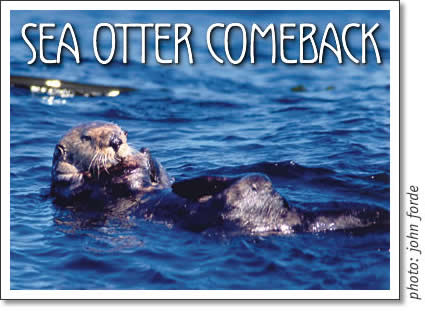
Unlike many stories of near-extinction that could be told, the sea otter’s is one of promise. After being extirpated on the BC coastline, 89 sea otters from Alaska were reintroduced to Kyuquot Sound on Northern Vancouver Island from 1969 to 1972. This population – now over 2,000 strong – continues to expand by as much as 19 percent per year. (Sea otters reappeared in Clayoquot Sound in the late 1990s.) With this repopulation comes the flourishing of kelp forests, a valuable habitat for many invertebrate species and an ideal nursery and larder for fish and other marine mammals.Today, the biggest challenge for sea otters lies once again in their relationship with people. Oil spills are deadly as even a small spot of oil damages the insulative properties of their fur. As well, sea otters now find themselves in competition for food. In the years that our coast has been sea otter free, sea urchins, crabs, geoducks, and other clams have become valuable commodities. Fisheries for these species have developed in the absence of otters. As the sea otters begin to return to Clayoqout and Barkley Sounds, our challenge now is to find ways in which to coexist.

Who is the RES?
The Raincoast Education Society (RES) is an independent, local, non-profit society dedicated to promoting research, education, and informed discussion about environmental and social sustainability.
The RES maintains the Raincoast Interpretive Centre (RIC) as a public venue for exhibits, presentations and discussions relating to the unique marine and terrestrial ecology and rich cultural heritage of the west coast.
RIC staff develop and deliver a broad range of educational and interpretive programs focused on the natural environment, cultures, and communities of the Clayoquot Sound region. Fall programs include the Raincoast Energy Series and school programs (Sea Otters and Mysterious Mudflats) for local and visiting school groups.
For more information call the RIC at 725-2560.
Tofino Nature & Wildlife Articles
- A Foggy Adventure May 2002
- A Whale‘s Tale Mar. 2003
- Black Bears in Tofino Oct. 2002
- Excursion to Flower Rock Apr. 2003
- Living Off the Land Jan. 2003
- Ocean Day: June 8th June 2002
- On Lone Cone Feb. 2003
- Orcas in Clayoquot Dec. 2002
- Sea Otters Sep. 2002
- Steller Sea Lions June 2002
- Stormwatching Jan. 2003
- Strawberry Island 2002 Mar. 2003
- Strawberry Island Scuttlebutt May 02 May 2002
- Strawberry Island Scuttlebutt Aug.02 Aug. 2002
- Strawberry Island Scuttlebutt Dec.02 Dec. 2002
- The Clear Black Sky Sep. 2002
- The Secret Life of Barnacles April 2011
- The Windbirds are Back! May 2002
- Wolves of Vargas Island Jan. 2003
tofino | tofino time | activities | accommodation | events | directory
maps | travel | food | art & artists | photos | horoscope | tides
search | magazine | issues | articles | advertising | contact us
hosted in tofino by tofino.net & studio tofino
© 2002-2014 copyright Tofino Time Magazine in Tofino Canada

Seotters have made a remarkable comeback since reappearing in Clayoquot Sound near Tofino in the late 1990s.