Tofino Canoe Carver Joe Martin
 Joe Martin grew up in the village of Opitsaht on Meares Island, directly
across from Tofino. He now lives at Echachis and is a member of the
Tla-o-qui-aht First Nation, which is a tribe of the Nuu-Chah-Nulth
First Nations. The name Clayoquot is an Anglicisation of the word Tla-o-qui-aht, which means ‘people who are different than they used to be’.
Joe Martin grew up in the village of Opitsaht on Meares Island, directly
across from Tofino. He now lives at Echachis and is a member of the
Tla-o-qui-aht First Nation, which is a tribe of the Nuu-Chah-Nulth
First Nations. The name Clayoquot is an Anglicisation of the word Tla-o-qui-aht, which means ‘people who are different than they used to be’.
His father, the late Chief Robert Martin, was a canoe carver who passed his skills and knowledge on to his son. “We spent a lot of time fishing for salmon in a dugout canoe, out near Wilf Rock, when I was a young boy,” says Joe. They would go out in a variety of conditions – for up to eighteen hours a day. If the winds became too strong, they would go to shore and sleep. Any fish they had caught were covered with kelp to keep them fresh. In the evening, the winds would ease, and the seas would smooth out, allowing them to head home.
In winter, they would check his father’s traplines on weekends, or whenever Joe was not in school. He had no choice in the matter–Joe would often sit in the canoe and stare back, wishing he could be on the beach, playing with his friends. “In retrospect, I’m glad to have learned about the ocean’s many moods, to have learned respect for the ocean”, he recalls. For Joe, respect means knowing your limits. “Learn to read your environment – clouds forming on the mountains, rings around the sun or moon. My dad could tell if the open sea was rough by listening to the waves break on the beach at Opitsaht”.
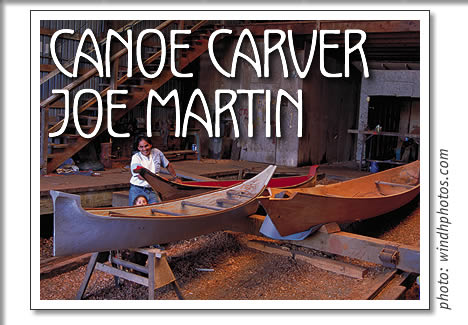
Since 1982, Joe has carved more than 20 canoes. They are made from huge red cedar logs, ranging in length from 14 to over 30 feet long. Some are sold, others are given away as gifts. Many are in use up and down the coast.
Joe and his brothers Carl and Bill all learned to carve canoes. “We weren’t taught–we learned by trial and error” Joe says. “One time I decided to try something a different way. My father just laughed–he said it was a waste of good wood. In the end, he was right!” Joe uses a chainsaw to speed the process. “I use the same principles as the old days-cut grooves, then split the wood away”. Many people inspired Joe, especially the elders. “The late Ben Andrews from Hesquiat showed me a real easy way to carve the bow and stern pieces. I still use his technique today”.
Joe has done some amazing voyages by canoe. He recalls, “In 1981 we paddled from Tofino up to Nootka Sound, around Nootka Island, and back. Eleven people departed, but only five or six returned– people bailed out along the way. We shot a seal and ate it, also a deer. We also caught salmon, barnacles and mussels, and an octopus. We had to launch through huge surf one day. The 27’ canoe nearly got airborne while punching out!”
In 1997 Joe took part in the Tribal Journeys paddle to Victoria for the opening of the North American Aboriginal Games. The group then crossed to Port Angeles, paddled out to Neah Bay at the tip of the Olympic Peninsula to visit relatives (the Makah are a tribe of the Nuu-Chah-Nulth nations). From there they paddled offshore, heading straight back to Tofino. “We decided to sleep out in the canoe one night, instead of heading in to shore. There were bodies everywhere, trying to find somewhere comfortable to sleep.”
“ The canoe has always played a central role to coastal First Nations – it was our car; the sea was our highway. It gave us access to our ha-houlth-ee (territories), and helped us protect our ha-houlth-ee. It allowed us to visit relatives all the way from Kyuquot to Neah Bay.”
The carving and use of canoes didn’t die out – it just slept for a while. “As a child, I was accustomed to seeing canoes on the beach at Opitsaht,” Joe recalls. Today, the revival of dugout canoes parallels the revival of a people’s identities. “The reservation system has disconnected people – the reserve boundaries are not our boundaries. Paddling dugout canoes really reconnects people back to the land. Abusers have sobered up and changed their lives – young and old.”
As for the future, Joe hopes to see the canoes used as a source of income, to take visitors paddling. “It is an excellent way to understand our culture, our ties to the land here, and our relationship to different people all up and down the coast’ Joe says. “And it is definitely the most environmentally friendly way to get around.”
Joe’s daughter Gisele Martin has started a new company to do just that, Tlaook Cultural Adventures. She will be offering guided canoe tours in Clayoquot Sound next summer.
First Nations Culture
- Tofino artist Carl Martin carves CWC trophy
- Canoe Carver Joe Martin Dec. 2002
- Nuu-Chah-Nulth Canoe Carving Sep. 2002
- Saa-Sis-Qua-Iis, the Canoe Mar. 2003
- The West was Never Won Aug. 2002
- Gisele Martin in Tofino April. 2004
tofino | tofino time | activities | accommodation | events | directory
maps | travel | food | art & artists | photos | horoscope | tides
search | magazine | issues | articles | advertising | contact us
hosted in tofino by tofino.net & studio tofino
© 2002-2014 copyright Tofino Time Magazine in Tofino Canada

Joe Martin - Tofino canoe carver and artist - grew up in the village of Opitsaht on Meares Island, directly across the water from Tofino.

quick links:
- tofino accomodations
- tofino calendar
- tofino surf report
- tofino horoscope
- march horoscope
- tofino map
- tofino fishing report
- tofino tides
- tofino weddings
tofino events:
- tofino concerts
- tofino events
- tofino movies
- tofino festivals
- tofino yoga classes
- tofino whale festival
tofino time magazine:
- tofino time march 2016
- tofino event listings march 2016
- tofino concerts in march 2016
- tofino movies in march 2016
- cox bay | wickaninnish beach
- chesterman beach
- tonquin beach
- tofino brewing co.
- tofino wedding guide
tofino accommodation:
- tofino cabin
- tofino camping
- bed & breakfasts in Tofino
- tofino hostels
- tofino motels
- tofino hotels
- tofino vacation rentals
- petfriendly accommodation
activities:
- tofino bike rentals
- tofino bear watching
- tofino bird watching
- tofino boat charters & cruises
- tofino fishing
- hot springs cove
- sea kayaking in tofino
- tofino storm watching
- tofino surfing
- tofino whale watching
- tofino yoga
shopping:
services:
- tofino yoga, spa & wellness
- tofino restaurants
- tofino internet cafes
- tofino travel & transportation
- tofino real estate
- tofino taxi services
- tofino wedding & events