Tofino Birding: Albatross - Spirits of the Wind and Sea
by George Bradd, Tofino

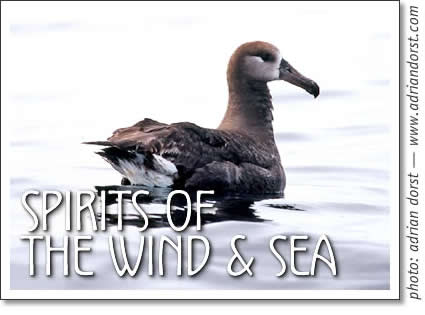
Far out of sight of land, offshore from Tofino is a world of birds few of us have imagined could exist. The open ocean is the domain of the Albatross, the ultimate pelagic bird that flies with grace and ease through storms so fierce that sailors say their prayers when caught at sea in such weather. Accounts of sailors, who while wondering whether their ship was going down, tell of Albatross flying with ease through gale force winds.Long distance flights powered by wind make them world travellers. A fifty year old Albatross will have flown a minimum of 3.7 million miles.
Two Albatross species can be found offshore of Tofino, the Black-footed and the Laysan Albatross. These birds are probably nesting in the Northwestern Hawaiian Islands. Long narrow wings make the perfect gliding machine with a ratio of wingspan to wing width of 18 to 1, and a wing lift drag ratio of 40 to 1 in the Wandering Albatross. Wingspans vary from 7 to 11 feet. To enable long hours of flight, their wings lock at the shoulder and elbow. They fly working with the wind and gravity. Their bones are lightweight, with the skeleton composing only 13% of their body weight. Calm weather strands them on the surface of the sea; they need wind to fly.
The pair bonding of Albatross is very strong; a bird that has lost its mate will sometimes wait on the nest for two months for the return of its partner. Starvation eventually forces it off the nest. An Albatross who has lost its mate will take 4 or 5 years to form a new pair bond.
Their long reproductive cycle constitutes a life pattern closer to humans than any other animal. The oldest living wild bird was over 60 years and some scientists believe they may live until 100 years. Some species don’t reach breeding age until 13 years. They lay a single egg and incubate it more than two months, with the male taking turns incubating. Parents take turns making long distance flights for food and spend only 5 to 10 days together in the entire breeding season of 12 months.
Many Albatross species are in now in a steep decline. Six of the 21 species of Albatross, “have shown an alarming decline” in just one year.
Historically the Japanese feather collectors and egg collectors were the greatest threat to nesting birds. The Japanese completely wiped out whole colonies of nesting birds and even continued sneaking onto Midway Island in Hawaii until 1915 in order to poach Albatross. The us government had declared the island a refuge in 1909. Commercial guano operations were used as a front for killing birds in some areas.
Now most nesting islands are protected and the greatest danger comes from long line fishing boats.
Every year an estimated 200 million hooks are set by long liners off the coast of Canada and the us. Longliner fishing boats are killing 100,000 Albatross every year. A bird with such a low reproductive rate cannot withstand such mortality rates. Recently I heard a report of a dead Albatross found on the rocks at Cox Bay in Tofino. It makes me wonder how many other dead ones are washed up on isolated beaches and not found by people.
I have spoken to fisherman in our area that admitted that they have killed Albatross while fishing for Black Cod.
Mortality can be reduced by over 90% using paired streamers and weighted lines. The streamers come off a line towed from the roof of the bait station and scare the birds until the fishing line has dropped too deep for the birds to get the bait on the hook. Pirate vessels doing long line fishing do not conform to regulations and account for the majority of the dead birds.
All boaters in Canada can help Albatross by not throwing any plastics in the sea while fishing. Bring your garbage back to shore and dispose of it. Most young albatross have plastics in their stomachs. You can tell where chicks died last year by the colourful piles of plastics that mark their gravesites on nesting beaches.
The young birds probably absorb toxic chemicals and plastics may starve or dehydrate weak chicks in the nest. Cigarette lighters will be swallowed while floating because they resemble natural foods. Abandoned drift nets also tangle Albatross and they eat pieces of broken nets that have deteriorated and washed up. Banning drift nets has benefited Albatross by reducing their entanglements and allowing more squid and dolphins to survive. Albatross will sometimes accompany dolphins and catch the squid surfacing to escape the dolphins.
An attitude of respect for one of the world’s largest birds will help them to survive their present downward spiral. Only we as people can make the decision to preserve these gentle giants of the air. We call them “gooney birds” because they lack fear of people. If we can’t save the Albatross how much ability do we have to survive as a species ourselves?
Next time you are huddled inside during a wind lashed stormy night in Tofino, remember there are still an entire race of living beings outside keeping watch on sailors at sea. The Albatross are the spirits of the wind and the sea.
George Bradd operates Just Birding, a Tofino birdwatching company. Visit his website at www.justbirding.com
tofino | tofino time | activities | accommodation | events | directory
maps | travel | food | art & artists | photos | horoscope | tides
search | magazine | issues | articles | advertising | contact us
hosted in tofino by tofino.net & studio tofino
© 2002-2014 copyright Tofino Time Magazine in Tofino Canada

Tofino bird watching guide George Bradd writes about Albatross in Tofino in this article for Tofino Time magazine.