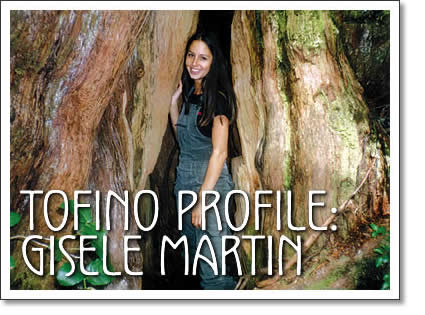
Tofino Profiles - Gisele Martin
by Shirley Langer
 I’ve always admired Gisele Martin—for years. She’s
pretty, she’s hip, she can sing; she can dance—there has
always been something special about her. Now, at age 26, she still
exudes that specialness. She and life partner, Doug Wright, are entering
their third business season of Tlaook Cultural Adventures, touring
people around Clayoquot Sound in traditional Nuu-cha-nulth canoes crafted
by her father and uncles. A new canoe for seven persons, the third
in the fleet, is in the garage, soon to be formally named and launched
with a blessing ceremony. The canoe they started with, The Hummingbird,
carrying eleven, is a replica of one used to lead the one-time Nu-cha-nulth
whaling fleet. Canoe number two, named Tsawalk—Everything Is
One—holds five. Shaking her head in wonder, she tells me, “I
never really attended high school, having dropped out half way through
grade nine, yet here I am, a businesswoman, making presentations .”
I’ve always admired Gisele Martin—for years. She’s
pretty, she’s hip, she can sing; she can dance—there has
always been something special about her. Now, at age 26, she still
exudes that specialness. She and life partner, Doug Wright, are entering
their third business season of Tlaook Cultural Adventures, touring
people around Clayoquot Sound in traditional Nuu-cha-nulth canoes crafted
by her father and uncles. A new canoe for seven persons, the third
in the fleet, is in the garage, soon to be formally named and launched
with a blessing ceremony. The canoe they started with, The Hummingbird,
carrying eleven, is a replica of one used to lead the one-time Nu-cha-nulth
whaling fleet. Canoe number two, named Tsawalk—Everything Is
One—holds five. Shaking her head in wonder, she tells me, “I
never really attended high school, having dropped out half way through
grade nine, yet here I am, a businesswoman, making presentations .”
The idea of utilizing traditional canoes for touring occurred to her when she worked as a whale watch guide, dismayed by the speed and noise of the motorized vessels. But she always thought someone else in the family would do it. However, a few years ago, she started looking into it, but realized she would need a business partner. Enter Doug, who Gisele says is very patient and capable dealing with the business stuff. “We’ve both learned tons,” she adds.
On the day of this interview, Gisele is preparing for a memorial potlatch honouring her grandfather, Robert Martin, who died four years ago. Talking with her, one soon sees that Gisele, a child of mixed parentage, is proud of her Tla-o-qui-aht roots. She talks about her heritage with enthusiasm, obviously identifying herself as First Nations. “What term do you prefer to use to describe yourself?” I ask. “Well, we’re not really Indians,” she replies, “and indigenous sounds like a disease, aboriginal sounds like something not normal, and I only use First Nations when the talk is political. So I use Tla-o-qui-aht or Nuu-cha-nulth.”
“ Your dad,” I ask, “what has he given you?” Surprisingly she holds up her feet. “Strong toes,” she says, “and my skin, of course. My sense of activism started with my dad at the Meare’s Island protest in 1984. That’s when the Martin brothers started carving their first canoe.” Gisele is thoughtful for a moment. “And he gave me whatever drive and passion I have about respect for the land and the rights of First Nations.”
Gisele was largely raised on the Esowista Reserve by her mother, whom she calls maman, Quebecoise Nicole Gervais. “Maman did a great job in providing my sister and I with our needs as we grew up. And she was relentless in nurturing our creative side—dancing and music lessons, drawing and painting—the real thing. There were no colouring books in our house. And thanks to her, I’m bilingual.” When questioned about growing up as a child of mixed parentage, she says it was challenging. “I would ask myself, ‘Who am I, exactly?’” Giselle has traveled considerably, and has come to understand people’s misunderstanding and stereotyping of “half breeds”. “My sister has come up with a much better term,” she says—double breed.
Her experiences and observations in Guatemala on a First Nations exchange organized by a human rights organization was responsible for opening her eyes to the relativity of social problems, of poverty and rights. “I became much more politically and socially savvy. The injustices against the Mayan people of Guatemala were so many and so deep, I saw that an aware person would have to boycott just about everything.” “So what did you do?” I enquire. Her reply surprises me. “I went to Vancouver, erased all issues from my mind and became a partying mass-consumer!” We both laugh. I could dig it. “But now,” she says, “bit by bit, I just share my knowledge of this area with people while touring. I’m learning more about traditional cultural knowledge, about the laws of the land which have been present in the minds of the people and have guided them for thousands of years without destroying it.” The passion glows on Gisele’s lovely face.
Sponsored by Patagonia, Gisele and her father Joe Martin recently accompanied Dan Lewis to Japan as emissaries of Friends of Clayoqot Sound. “We met with companies purchasing forest products, and explained First Nations cultural values of the forest. The executives were not aware of First Nations issues and problems in Canada, and they were intrigued. They said they would look into it further.”
I asked Gisele about any resemblance between First Nations and Japanese. “It’s true,” she responded, laughing. “One time we said, look, that man looks just like George Atleo. George Atleo with an Asian twist. And my father—he blended right in.” “I asked her to visualize an image from Japan she still remembers vividly. “On the subway I saw a passenger who looked like a futuristic alien dressed in a silver punk suit, huge silver platform boots, sporting a poof hair style. Right next to him sat an old Japanese man wearing wooden sandals who looked as though he had stepped out of an ancient Japanese fairy tale.” Did she have a good time in Japan, I wanted to know. “Yes, especially the evening I attended a karaoke club—just like the scene in the movie Lost In Translation— with people who spoke no English, so I was not self conscious and threw myself completely into singing cheesy love ballads!”
When questioned about how she enjoys Tofino, she credits Tofino with a strong creative streak, says she plans to remain in Clayoquot Sound, so “hopes Tofino doesn’t blast away and pave over all its greenness.” Then she offered wise advice for a 26 year-old businesswoman. “We must remember why people come here, that they come to see and admire nature. We must honour and respect that.”
I can only agree.
Shirley Langer has resided in Tofino since 1995. She describes herself as a woman about town with a well developed civic consciousness.
First Nations Culture
- Tofino artist Carl Martin carves CWC trophy
- Canoe Carver Joe Martin Dec. 2002
- Nuu-Chah-Nulth Canoe Carving Sep. 2002
- Saa-Sis-Qua-Iis, the Canoe Mar. 2003
- The West was Never Won Aug. 2002
- Gisele Martin in Tofino April. 2004
Tofino Profiles
- Tofino Business: Marc the Bicycle Guy June 2005
- Tofino Business: Pasticceria Conradi July 2005
- Tofino Profile: Spencer Baird February 2004
- Tofino Profile: Lyra LeBlanc January 2004
- Tofino Profile: David Pitt-Brooke August 2004
- Tofino Profile: Tim Cariou Deember 2004
- Tofino Profile: Art Clarke February 2005
- Tofino Profile: Keith Crawford Le Shana December 2003
- Tofino Profile: Stephanie Huges November 2005
- Tofino Profile: Jim Hugh October 2005
- Tofino Profile: Joe Kranabetter May 2005
- Tofino Profile: Jessica Macintosh April 2005
- Tofino Profile: Islay Macleod June 2004
- Tofino Profile: Gisele Martin April 2004
- Tofino Profile: Mary Martin October 2004
- Tofino Profile: Lise Saurette January 2008
- Tofino Profile: Candace Steven September 2004
- Tofino Profile: Marion Syme December 2005
- Tofino Profile: Sarah Timberlake November 2004
tofino | tofino time | activities | accommodation | events | directory
maps | travel | food | art & artists | photos | horoscope | tides
search | magazine | issues | articles | advertising | contact us
hosted in tofino by tofino.net & studio tofino
© 2002-2014 copyright Tofino Time Magazine in Tofino Canada

Tofino profile of Giselle Martin, and her business Tlaook Cultural Adventures, a First Nations eco-tourism company in Tofino, offering Nuu-Chah-Nulth canoe trips.

quick links:
- tofino accomodations
- tofino calendar
- tofino surf report
- tofino horoscope
- march horoscope
- tofino map
- tofino fishing report
- tofino tides
- tofino weddings
tofino events:
- tofino concerts
- tofino events
- tofino movies
- tofino festivals
- tofino yoga classes
- tofino whale festival
tofino time magazine:
- tofino time march 2016
- tofino event listings march 2016
- tofino concerts in march 2016
- tofino movies in march 2016
- cox bay | wickaninnish beach
- chesterman beach
- tonquin beach
- tofino brewing co.
- tofino wedding guide
tofino accommodation:
- tofino cabin
- tofino camping
- bed & breakfasts in Tofino
- tofino hostels
- tofino motels
- tofino hotels
- tofino vacation rentals
- petfriendly accommodation
activities:
- tofino bike rentals
- tofino bear watching
- tofino bird watching
- tofino boat charters & cruises
- tofino fishing
- hot springs cove
- sea kayaking in tofino
- tofino storm watching
- tofino surfing
- tofino whale watching
- tofino yoga
shopping:
services:
- tofino yoga, spa & wellness
- tofino restaurants
- tofino internet cafes
- tofino travel & transportation
- tofino real estate
- tofino taxi services
- tofino wedding & events